Duet Cats: Music & Meow Game
- 4.4
- Rating
- 50.00M
- Installs
- Free
- Price

 Analysis by App-foxy
Some casual games ask for a few spare minutes, but Duet Cats: Music & Meow Game tries to make those minutes feel like a tiny performance. I found its appeal immediately: the screen is built around cute cats, simple taps, and a playful musical mood rather than complicated rules or long-term strategy. It is the kind of game I can open when I want something cheerful without having to learn a dense control system first.
That simplicity is also the main thing to understand before downloading it. This is not a traditional rhythm game aimed at demanding musicians, and it is not a deep cat simulation. It is a casual game from AMANOTES PTE. LTD. that combines timing, feeding, visual charm, and short bursts of interaction. The result is easy to approach, though players looking for serious rhythm challenges or a large strategic layer may eventually find it lightweight.
Why the first few minutes work so well
My first impression was shaped less by complexity and more by presentation. The cats are the immediate focus, and the basic interaction is easy to understand: I tap along as the musical action develops and use those taps to keep the cats engaged. There is very little friction between launching the game and understanding what I am supposed to do, which matters a lot for a title designed for casual sessions.
You May Also Like

 Blood Strike: 2.5 Anniversary
Blood Strike’s Loadouts Turn Every Drop Into a Tactical Gamble
A close look at Blood Strike’s custom loadouts: how fast access to signature weapons reshapes its battle royale rhythm, rewards preparation, and narrows the gap between fights.

 Pandora - Music & Podcasts
Pandora’s Music Is Easy to Start, but Harder to Recover
Pandora’s strength is its low-effort path from a seed to a station. Its weak spot is how much confidence it asks you to place in connection, setup, and quiet recovery.

 8 Ball Pool
 Is Built on Rivalries, Rematches, and Routine
A close look at the rivalries, rematches, shared routines, and unanswered safety questions that turn a quick pool match into a persistent mobile community.

 Samsung Music
’s Quiet Strength Is Playing What You Already Own
Its reach comes less from spectacle than from dependable access to a personal library. That simplicity is both the app’s strongest retention engine and its ceiling.

 AccuWeather: Weather Radar
AccuWeather Review: A Quick, Clear Forecast for Everyday Decisions
For everyday plans, the best forecast is the one you can understand quickly. AccuWeather makes rain timing, radar, and local conditions easy to act on, with a few trade-offs.

 Hill Climb Racing
Why Hill Climb Racing Still Turns Crashes Into One More Run
A tiny car, a bumpy hill and one more upgrade: Hill Climb Racing keeps resurfacing because its simple chaos makes every near-miss feel personal.
More From Our News Desk
View All News


The free entry point helps make that first experiment painless. The game is listed as free, with optional in-app purchases ranging from a small amount to a much larger per-item amount. I would treat that range as a reason to look carefully at purchase prompts rather than as a reason to avoid the game altogether. Someone who only wants a quick musical distraction can begin without paying, while a more enthusiastic player may be tempted by optional extras during longer use.
The audience is broad as well. Its Everyone age rating makes the tone approachable for family play, and the controls are simple enough for someone who does not normally play games. I could imagine handing it to a younger player for a short session, although I would still keep an eye on purchase prompts if the device is shared. The cheerful style is welcoming, but “easy to start” does not automatically mean “best for every player.”
One practical strength is how naturally it fits into small gaps in the day. I can picture playing while waiting for a friend, taking a short break between tasks, or letting a child try a few rounds during a quiet moment. It does not demand a long setup or a large commitment. That makes it more useful as a mood reset than as a game I would plan an entire evening around.
The game has also built a substantial audience, with over 50 million installs and an average rating of 4.5 from around 102 thousand ratings. Those figures do not guarantee that every player will enjoy it, but they do match my impression that the concept is immediately understandable and broadly appealing. The store page also shows around 6.1 thousand written reviews, suggesting that many players have found enough personality in the idea to comment on it.
A visual language built around softness and reaction
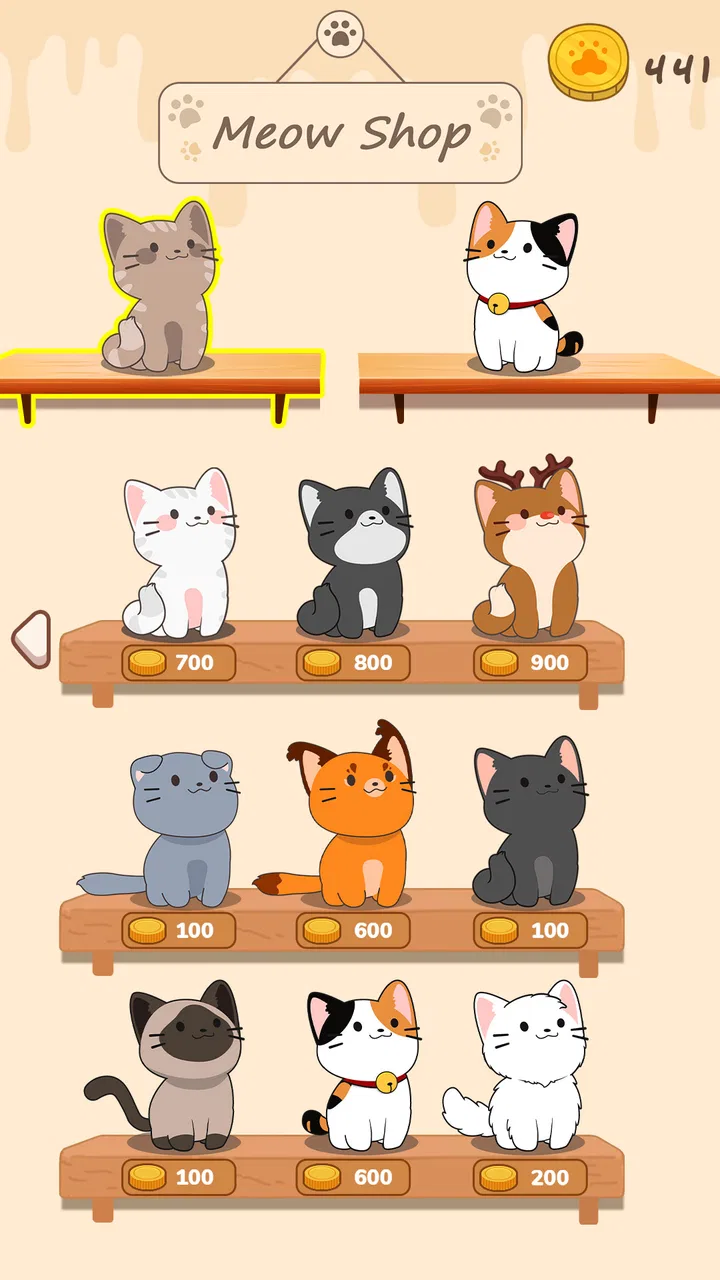
The art direction does useful mechanical work. The cats are not merely decoration placed around a rhythm interface; their presence gives the tapping a clear emotional purpose. Instead of feeling like I am pressing anonymous notes, I feel as though I am helping a character participate in a small musical exchange. That connection makes missed timing less harsh and successful timing more satisfying.
The setting is intentionally compact. Rather than sending me through a large world with maps, quests, or lore to track, the game concentrates attention on the cats and the immediate play space. I think that restraint is important. The mood would be weakened if too many menus or systems competed with the central image of cats making music together.
Color, character expression, and movement carry much of the personality. Even when the underlying action is repetitive, the presentation keeps it from feeling completely mechanical. I tend to forgive a simple loop more readily when the characters give that loop a recognizable identity. Here, the cats turn a basic timing exercise into something closer to a playful animated scene that I happen to control.
There is a useful distinction between charm and depth. The art can make the opening sessions feel fresh, but it cannot replace variety forever. If I were deciding whether to keep the game installed for months, I would focus less on the cuteness and more on whether the available musical interactions continue to offer enough change. Players who need constant novelty may enjoy the first impression more than the long-term routine.
One tip I found helpful is to treat the visual feedback as part of the timing lesson. Rather than staring only at the point where I tap, I watch the cats and the movement around them. Their reactions help me stay connected to the beat, especially when I am playing casually and do not want to count every note. This is a small but meaningful advantage over rhythm games that communicate almost everything through abstract bars or circles.
How the sound turns tapping into a shared moment
The audio concept is the heart of the experience. The cats do not simply sit beside a soundtrack; their meows and musical responses are part of the reason the actions feel playful. That gives the game a distinctive sound identity. A conventional rhythm title might make me feel like I am following a song, while this one makes me feel like I am helping stage a duet between characters.
That difference changes the emotional pressure of mistakes. In a harder rhythm game, missing a note can feel like breaking a performance. Here, the tone is gentler. I am encouraged to continue because the sound remains cute and inviting rather than turning every error into a serious failure. For beginners, that can make the first contact with rhythm mechanics much less intimidating.
At the same time, the music should not be mistaken for a full rhythm-training system. I would not choose this as a replacement for a game built around precise difficulty levels, complex patterns, or competitive score chasing. Its sound design supports the mood first and the challenge second. The beat gives structure to the tapping, but the overall experience remains relaxed and character-driven.
I recommend using headphones when the surroundings are quiet enough, especially if the visual action starts to feel repetitive. The small vocal details are easier to appreciate when they are not competing with traffic, conversation, or television. In a noisy environment, the game can still be played, but some of the charm is reduced and timing may feel less natural.
There is also a practical reason to avoid playing with sound completely ignored. Because the game is built around musical cues, looking away from the screen or playing while distracted can make the interaction feel flatter. I get more from it when I give it a few uninterrupted minutes instead of treating it as background tapping. That is a useful compromise: the game is casual, but it still benefits from a little attention.
Where the mechanics fit—and where they may not
The core mechanics are deliberately approachable. Tapping is the central skill, and the cats provide a clear reason to keep the rhythm going. I do not need a complicated control scheme, a large inventory, or a long tutorial to understand the basic loop. That makes it suitable for players who enjoy small interactive toys, family-friendly games, or anything that can be learned in a single sitting.
The best way to approach it is as a sequence of short performances rather than a conventional campaign. I play, react to the rhythm, enjoy the cats, and decide whether I want another round. This pacing is a strength when I am tired or only have a few minutes. It is less convincing when I want a sense of progression that carries from one session to the next through strategy, exploration, or character development.
Compared with typical casual puzzle games, the appeal here is more sensory than problem-solving. A puzzle game may give me a board to optimize or a chain reaction to plan. This title gives me timing and presentation instead. Compared with more demanding rhythm games, it is friendlier and less intimidating, but also less suited to players who want mastery to be the main reward.
That makes the choice fairly clear. I would recommend it to someone who likes cute characters, musical tapping, and low-pressure play. I would be more cautious about recommending it to a player who dislikes repetition, wants deep customization, or expects every session to introduce a new system. The game’s identity depends on doing a small number of things consistently well rather than trying to cover every casual genre at once.
A useful everyday workflow is to use it as a transition game. I might play a short session after finishing work, before starting a study block, or while waiting for an appointment. The important part is to set my own stopping point, because the easy restart loop can encourage “just one more” even when I originally intended to play briefly. Its low-pressure design is relaxing, but it is still worth treating optional purchases and play time deliberately.
The current version is 1.5.36, and the game supports devices running Android 7.0 or later. That makes compatibility fairly accessible for people using older Android hardware, though the actual comfort of play will still depend on the device’s screen, audio, and performance. A small or sluggish phone could make tapping less pleasant, particularly when the timing feels dependent on seeing and hearing the action clearly.
Because it is free to start, I would test it in the way I expect to use it. If I want a quick family-friendly distraction, I would play a few short sessions and see whether the cat reactions remain enjoyable. If I am considering purchases, I would first decide what I actually want from the game: more ways to personalize the experience, longer engagement, or simply the satisfaction of supporting something I already enjoy. That prevents the free download from turning into an unplanned expense.
The trade-off between comfort and lasting variety
The strongest trade-off is straightforward: the same simplicity that makes the game welcoming can limit its staying power. I like that I can understand the basic action quickly, but I also notice that the experience relies heavily on its cute presentation and musical mood. Once that first surprise fades, my continued interest depends on whether I still enjoy repeating the central interaction.
This is not a criticism of the design so much as a warning about expectations. Many casual games work best as small, repeatable pleasures rather than as permanent main games. I would keep this one available for moments when I want something light and cheerful, not necessarily as the only game on my phone. That role suits it better than demanding that it provide the depth of a larger rhythm or simulation title.
Another trade-off concerns attention. The game is easy to pick up, but the musical idea works best when I actually listen and watch. If I play with the sound muted, rush through the interaction, or divide my attention between several tasks, I lose much of what makes the cats feel like performers rather than animated buttons. Players seeking a completely passive experience may find that it asks for more involvement than expected.
The purchase range deserves similar realism. A free game with optional items can be perfectly enjoyable without spending, but the presence of purchases means I would not hand it to a child on an unrestricted account. That is not unique to this title, yet it matters here because the friendly visual style can make optional extras feel especially tempting. I would make the payment settings part of the setup, particularly on a family device.
For accessibility of play, the simple controls are a clear advantage. Someone who finds multi-button games overwhelming can understand the basic interaction quickly. However, tapping still depends on being able to see the timing and hear the musical cues comfortably. If a player needs larger interfaces, strong visual contrast, or a different control method, I would suggest checking the actual experience on their device before committing to longer sessions.
My verdict on the mood it creates
What stays with me is the coherence between the art, sound, setting, and pacing. The cats look like they belong in the musical interaction, the meows give tapping a personality, and the short-session structure keeps the mood from becoming demanding. Nothing feels as though it is trying to turn this into a serious strategy game. That focus is why the experience is easy to recommend in the right situation.
I would choose it over a standard casual puzzle when I want warmth and character instead of optimization. I would choose a more advanced rhythm game when I want difficult patterns, precision, or a stronger sense of mastery. I would choose a deeper pet game when I want care systems, exploration, or a more persistent relationship with animals. The game earns its place by occupying a narrower but clearly defined space between those alternatives.
My final advice is to download it if the idea of tapping along with expressive cats sounds appealing, especially if you value a relaxed game that can fill a few spare minutes. Go in expecting a charming rhythm-themed activity, not an expansive adventure. I found the mood more memorable than the mechanics, but that is exactly the point: the presentation makes a simple interaction feel like a tiny, cheerful performance.
For me, that is enough to make it worth keeping around. It is free to begin, rated for Everyone, and developed by AMANOTES PTE. LTD., with a large existing audience behind it. I would recommend it to casual players, families who can manage purchase settings, and anyone who enjoys cute audio-visual feedback. I would skip it in favor of a more demanding alternative if I needed deep progression or a serious test of rhythm skill, but as a compact mood-lifting game, it understands its purpose very well.
FAQs for Duet Cats: Music & Meow Game
01What is the main objective of Duet Cats: Music & Meow Game?
Duet Cats: Music & Meow Game is a rhythm-based game where you control two adorable cats to the beat of catchy tunes. The objective is to synchronize their movements to collect musical notes, avoid obstacles, and achieve high scores. As you progress, the game challenges your timing and coordination skills, providing a fun and engaging musical experience.
02Is Duet Cats: Music & Meow Game suitable for all ages?
Yes, Duet Cats: Music & Meow Game is designed to be family-friendly and suitable for players of all ages. Its simple controls, delightful graphics, and charming music make it accessible and enjoyable for both kids and adults. The game’s increasing difficulty levels ensure that it remains challenging for older players while still being approachable for younger ones.
03Does Duet Cats: Music & Meow Game require an internet connection?
Duet Cats: Music & Meow Game can be played offline, allowing users to enjoy the game without an internet connection. However, some features, such as leaderboards or downloading additional content, may require internet access. This makes it perfect for playing on the go, whether you’re commuting or in areas with limited connectivity.
04Are there in-app purchases in Duet Cats: Music & Meow Game?
While Duet Cats: Music & Meow Game is free to download and play, it does offer in-app purchases. These can include items like additional songs, cosmetic upgrades for your cats, or power-ups to enhance gameplay. While these purchases can enhance the experience, they are optional and not required to enjoy the full scope of the game.
05What devices are compatible with Duet Cats: Music & Meow Game?
Duet Cats: Music & Meow Game is available for both Android and iOS devices. It is optimized to run smoothly on a wide range of smartphones and tablets, ensuring a seamless experience regardless of your device’s specifications. Always check the app store for the minimum system requirements before downloading to guarantee compatibility.
Pros
- Engaging rhythm-based gameplay.
- Cute and charming cat characters.
- Variety of songs to play.
- Simple controls for easy play.
- Frequent updates with new content.
Cons
- Ads can be intrusive.
- Limited song selection at start.
- In-app purchases can be pricey.
- Requires internet for some features.
- May not appeal to non-cat lovers.

Duet Cats: Music & Meow Game
Gallery